Measurable trade show success: how digital business cards minimize your time-to-follow-up
Why time-to-follow-up decides your trade show ROI and how digital business cards bring hot leads straight into the CRM before they cool down.
发布于 2026年6月4日 · 4 分钟阅读
As a sales manager, you know how much a good trade show costs: booth rental, staff, travel, materials. The return on investment, however, is not created at the trade show itself, but in the days that follow. What matters is how quickly your hot contacts turn into real conversations. Digital business cards shorten exactly this span, because they move leads straight into your sales process without friction loss. The result: more deals from the same contacts.
The trade show hangover problem: why hot contacts cool down after the event
After three intense trade show days, the team returns with a stack of paper business cards. Then the trade show hangover begins: cards have to be typed up, notes deciphered, and records transferred into the CRM. In practice, the stack often disappears into a drawer for days, because day-to-day business takes priority.
During this time, the contacts cool down. The prospect who was still enthusiastic at the booth has long since seen three competitors and half-forgotten the conversation with you. Every day without a response lowers your chance of closing. The trade show hangover problem is therefore not an organizational detail, but a direct revenue lever.
What does time-to-follow-up mean and why does it decide the deal?
The time-to-follow-up describes the span between the first contact and your first qualified response. Studies from B2B sales have shown the same effect for years: the shorter this span, the higher the chance of a follow-up conversation. A lead you contact within a few hours is many times more valuable than one that is only handled after a week.
The reason is psychological: as long as your company is present and relevant in the prospect’s mind, the follow-up communication comes easily. If too much time passes, you have to laboriously rebuild the entire context. A low time-to-follow-up is therefore one of the few levers you can pull to directly influence your trade show ROI.
Work it out concretely for once: if your team collects several hundred contacts at a large trade show and just the manual typing alone costs one to two minutes per card, that adds up to hours of pure capture work before the first lead has even been contacted. It is this lost time that lets your best contacts cool down. Every minute you save in the capture process flows directly into a faster, higher-quality first contact.
The digital workflow: from the smartphone tap straight into the company CRM
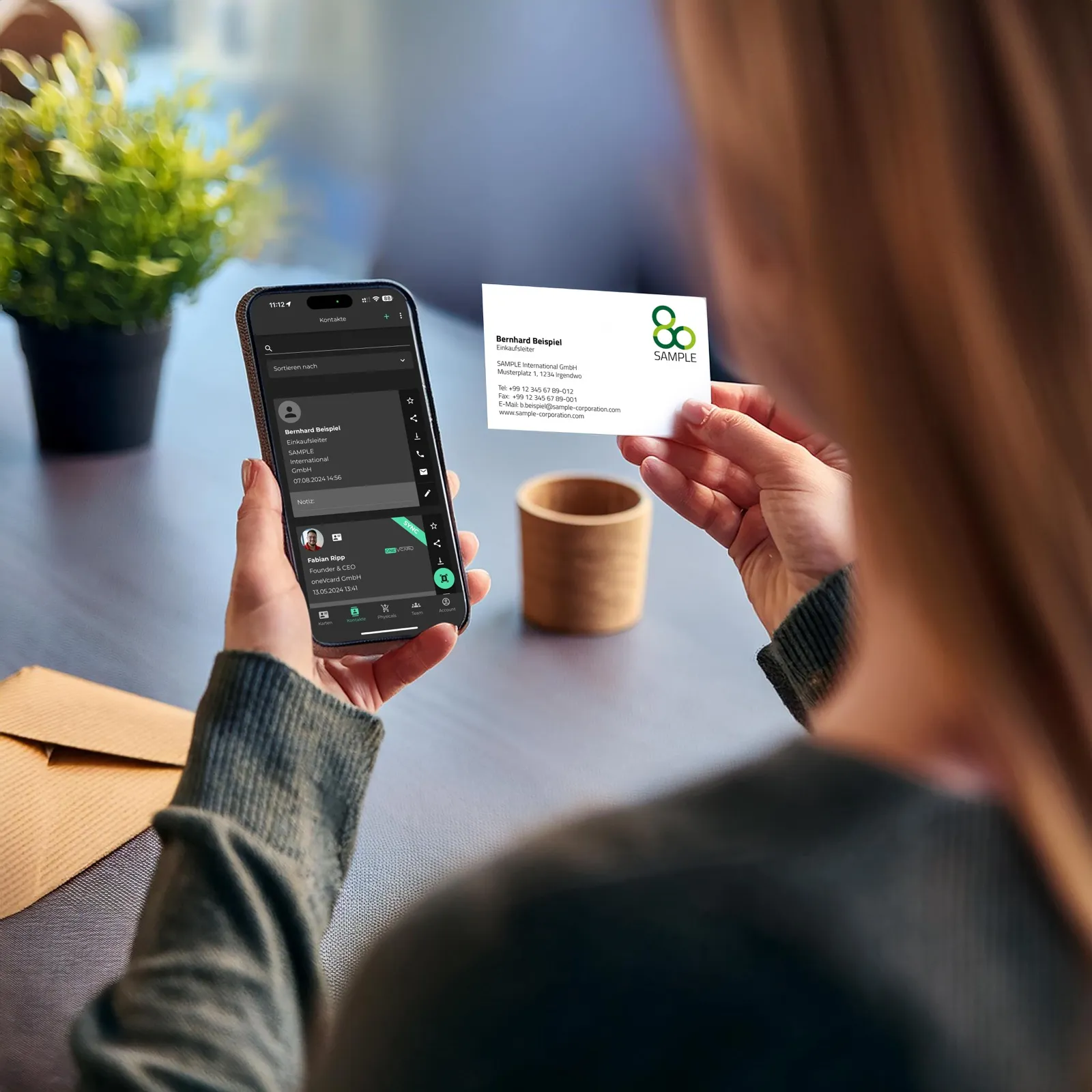
With digital business cards you replace the error-prone media break with a continuous data flow. The prospect taps their smartphone against your NFC card or scans a QR code, leaves their data, and the contact is already captured in a structured way. Conversely, your team uses the business card scanner to capture the other person’s data directly in digital form.
Instead of a paper stack, a clean record is created that converges centrally in the team contacts and lead management and flows from there into the company CRM. Notes on the content of the conversation can be added immediately at the booth. The lead is therefore ready for follow-up not after days, but in real time, including all relevant information.
3 ways to maximize your trade show ROI through digital processes
- Immediate lead qualification at the booth. Capture how hot a contact is right during the conversation and prioritize the follow-up. This way you handle the most valuable leads first, instead of fighting through an unsorted stack.
- Automated handover to the CRM. When data moves into the system without manual typing, the biggest bottleneck after the trade show disappears. Your sales team starts the follow-up on the same day, not in the following week.
- Measurable analysis. Because every contact is captured digitally and with its source, you can cleanly evaluate success per trade show. You know which event delivered how many deals, and you invest your budget more deliberately in the future.
Conclusion: whoever writes faster wins the B2B customer
In B2B sales, it is often not the best product that decides, but the fastest, most relevant response. Digital business cards drastically lower your time-to-follow-up, because they eliminate the media break between the trade show booth and the CRM. You handle hot leads while they are still hot, and turn the expensive trade show appearance into measurable revenue. In short: whoever writes faster wins the customer.
Do you want to digitalize your trade show workflow? Book a consultation or send us your inquiry via the form below.